GoTrek Travels JournalTHE CHAR DHAM YATRA
A Pilgrim's Complete Guide
Four shrines, four rivers, one circuit through the Garhwal Himalaya — the story, the route, and everything you need to know before you go.
12 min read•Updated for the 2026 season
The Char Dham — literally “the four abodes” — is the name given to four Himalayan shrines tucked into the folds of Uttarakhand's Garhwal region: Yamunotri, Gangotri, Kedarnath, and Badrinath. Together they mark the source, real or symbolic, of two of India's most sacred rivers — the Yamuna and the Ganga — and honour Shiva and Vishnu at the very edge of habitable altitude in the Himalaya.
It's worth clearing up a common confusion early. This circuit is often called the “Chota Char Dham” (the “small” Char Dham) to distinguish it from the all-India Char Dham established by the 8th-century philosopher-saint Adi Shankaracharya — Badrinath in the north, Puri in the east, Dwarka in the west, and Rameswaram in the south. Badrinath is the one site shared by both. The Garhwal circuit is a regional pilgrimage in its own right, but it draws far more annual footfall than any of the four cardinal dhams individually, simply because all four shrines sit within a few hundred kilometres of each other and can be completed in a single, if demanding, journey.
What makes this circuit distinct is geography as much as theology. Each dham sits at the head of its own valley, at the literal or figurative source of a river, reachable only by a specific, unchanging combination of mountain road and footpath. The order in which pilgrims visit them — Yamunotri first, Badrinath last — isn't scripturally mandated, but it follows the shape of the land so closely that almost nobody does it any other way.
The Circuit
The Four Dhams
First Dham
Yamunotri
Yamuna is worshipped as the daughter of the sun god Surya and the twin sister of Yama, the god of death. According to tradition, bathing in her waters at their source spares a pilgrim an untimely death — which is one reason Yamunotri is visited first: almost as an act of humility before the harder legs of the journey begin.
Presiding deity — Goddess Yamuna
Sacred river — Yamuna
Altitude — 3,293 m
District — Uttarkashi
From Rishikesh — ~210 km (drive to Janki Chatti/Hanuman Chatti)
Trek — 5–6 km one-way trek (or mule/palki/helicopter) from Janki Chatti
Temple & Architecture
The trek itself is short by Himalayan standards — 5 to 6 kilometres one-way from Janki Chatti, walkable in a few hours, though mule, palki, and helicopter options exist for those who need them. The present shrine is a fairly modest stone structure, rebuilt in the 19th century by Maharani Gularia of Jaipur after earlier temples were destroyed by avalanches and earthquakes — a pattern that repeats at nearly every dham in this circuit, since these valleys sit on some of the most seismically and glacially active terrain in the Himalaya.
Ritual for Pilgrims
Beside the temple, the Surya Kund hot spring does something unusual: pilgrims wrap rice and potatoes in cloth and lower them into the boiling water, then eat the cooked prasad — food quite literally prepared by the mountain — as part of the ritual. The custom of bathing in the Surya Kund before entering the temple is nearly universal among visiting pilgrims.
For the Photographers
The final kilometre, where the trail hugs a cliff above the Yamuna gorge with the temple roof just visible through rising spring mist.
Second Dham
Gangotri
The story of Ganga's descent to earth is one of the great narrative arcs in Hindu mythology. King Bhagiratha performed centuries of penance to bring the celestial river down from the heavens, hoping her waters would purify the ashes of his ancestors, who had been cursed to remain unliberated. The problem was one of force: a river falling directly from the sky would have shattered the ground on impact. Shiva agreed to intervene, catching Ganga's full descent in his matted locks and releasing her gradually, channel by channel, so her power reached the earth without destroying it. The rock beside the temple — Bhagirath Shila — marks where the king is said to have completed his penance.
Presiding deity — Goddess Ganga
Sacred river — Bhagirathi (the true source stream of the Ganga)
Altitude — 3,100 m
District — Uttarkashi
From Rishikesh — ~250 km, motorable road directly to the temple town
Trek — No trek required to the temple itself (Gaumukh glacier trek is a separate 18 km extension)
Temple & Architecture
Unlike Yamunotri, no trek is required here — the road runs directly into the temple town. The white temple with its distinctive pointed spire, built in the early 19th century by the Gorkha commander Amar Singh Thapa, sits right beside the Bhagirathi's rapids; the sound of the river is constant throughout the complex. A short distance away, submerged stone steps mark where Shivling, a rock formation said to be Shiva's own lingam, becomes visible only when the winter water level drops low enough.
Ritual for Pilgrims
Pilgrims collect Gangajal here — water considered the purest anywhere along the river's 2,500-kilometre course to the Bay of Bengal — often sealing it in copper vessels to carry home and keep for years. A separate, much longer trek from Gangotri leads 18 kilometres further up the valley to Gaumukh, the glacial snout where the Bhagirathi physically emerges from ice; this is distinct from the temple visit and isn't part of the standard Char Dham itinerary.
For the Photographers
Bhagirath Shila at golden hour, with the temple spire framed against the first deodar-forested ridgeline of the Gangotri range.
Third Dham
Kedarnath
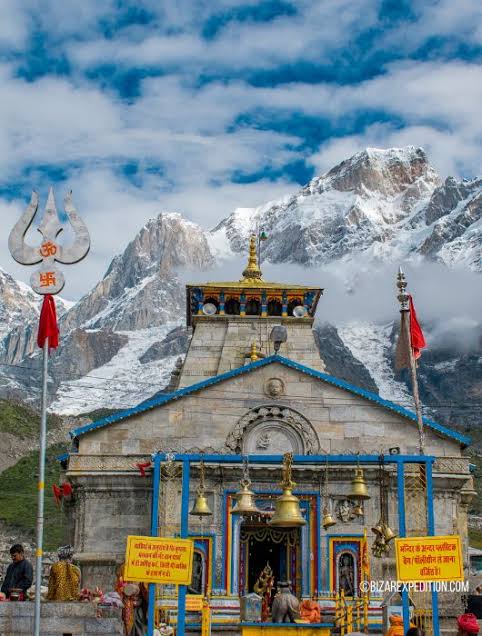
Kedarnath carries the circuit's most demanding trek and its most dramatic mythology. Local tradition holds that the Pandavas, seeking Shiva's forgiveness after the bloodshed of the Kurukshetra war, pursued him into these mountains. Shiva, unwilling to grant an audience, took the form of a bull and attempted to escape by diving into the ground, leaving behind a hump-shaped rock — the same irregular form worshipped as the Jyotirlinga today. Centuries later, in the 8th century CE, the philosopher-saint Adi Shankaracharya is credited with rediscovering and formally re-establishing the shrine; a samadhi believed to be his own stands directly behind the temple.
Presiding deity — Lord Shiva (as Kedarnath, one of the twelve Jyotirlingas)
Sacred river — Mandakini
Altitude — 3,583 m
District — Rudraprayag
From Rishikesh — ~215 km drive to Sonprayag/Gaurikund, then trek
Trek — 16–18 km one-way trek from Gaurikund (or pony/palki/helicopter)
Temple & Architecture
The temple itself is a massive structure of grey stone, built to withstand extreme mountain weather — and it has. During the catastrophic Uttarakhand floods of 2013, when a glacial lake outburst sent a wall of water and debris through the valley and devastated the town around it, the temple survived almost entirely untouched. A large boulder that lodged directly behind the structure during the flood is widely credited with splitting the debris flow and diverting it around the sanctum — an event many pilgrims now regard as further proof of the site's sanctity.
Ritual for Pilgrims
The trek to Kedarnath runs 16 to 18 kilometres one-way from Gaurikund, climbing steadily to just under 3,600 metres, and is by far the most physically demanding leg of the entire circuit. Pony, palki, and helicopter services all operate along the route, though helicopter seats in peak season routinely sell out months ahead of travel. Inside the complex, pilgrims circle the temple and touch the irregular Jyotirlinga form; many also stop at the nearby Bhairavnath temple, dedicated to the deity considered the valley's guardian once the main shrine closes for winter.
For the Photographers
The classic frame — temple in the foreground, Kedarnath peak (6,940 m) rising directly behind it, best caught in the clear light just after sunrise before afternoon cloud builds.
Fourth Dham
Badrinath
The story behind Badrinath's name is a quieter one than Kedarnath's, but no less central to the pilgrimage. Vishnu is said to have meditated at this spot for millennia, so deeply absorbed that he failed to notice an approaching Himalayan winter. His consort Lakshmi took the form of a badri — a jujube or Indian plum tree — and stood over him, using her branches to shield him from snow and hail. The site's name, from 'Badri-van' or 'forest of berries', commemorates her protection.
Presiding deity — Lord Vishnu (as Badrinarayan)
Sacred river — Alaknanda
Altitude — 3,133 m
District — Chamoli
From Rishikesh — ~295 km, motorable road directly to the temple town
Trek — No trek required — temple sits beside the main road
Temple & Architecture
Like Gangotri, no trek is required — the road runs directly to the temple town. The shrine's bright conical spire and colourfully painted facade, repainted before every seasonal opening, sit beside the naturally hot Tapt Kund springs, where pilgrims traditionally bathe before entering for darshan. The current structure dates largely to an 18th-century rebuilding project undertaken by a Garhwal king, following damage to earlier versions from glacial and seismic activity — the same recurring hazard that shaped the history of every shrine on this circuit.
Ritual for Pilgrims
One detail surprises many first-time visitors: the temple's head priest, the Rawal, is traditionally a Nambudiri Brahmin brought from Kerala, a tradition said to trace back to Adi Shankaracharya himself and maintained without interruption for over a thousand years. Across the Alaknanda river from the main complex, the Sheshnetra viewpoint offers the best single photograph of the pilgrimage's final stop — the entire temple complex lined up against the twin peaks of Nar and Narayan.
For the Photographers
Across the Alaknanda from the Sheshnetra viewpoint, where the entire temple complex and the twin peaks of Nar-Narayan line up in a single frame.
Planning
Route & Suggested Itinerary
Most pilgrims begin from Haridwar or Rishikesh, the last major towns before the road climbs into the Garhwal hills. A complete circuit typically takes 10 to 12 days, including time to acclimatise to altitude and a buffer day for the weather delays and road closures that are common during peak season. Compressed 8-day versions exist, but they leave almost no margin if a landslide closes a road for even half a day — a frequent enough occurrence that experienced operators build slack into the schedule deliberately.
| Day | Leg | Notes |
|---|
| 1 | Haridwar/Rishikesh → Barkot | Overnight stop before Yamunotri |
| 2 | Barkot → Janki Chatti → Yamunotri → Barkot | 5–6 km trek each way |
| 3 | Barkot → Uttarkashi | En route stop at Kuthnaur/Dharasu |
| 4 | Uttarkashi → Gangotri → Uttarkashi | No trek — road to temple gate |
| 5–6 | Uttarkashi → Guptkashi/Sonprayag → Gaurikund → Kedarnath | 16–18 km trek; the demanding leg |
| 7 | Kedarnath → Gaurikund → Guptkashi/Rudraprayag | Descent day; rest recommended |
| 8–9 | Rudraprayag → Badrinath → Rudraprayag/Srinagar | No trek — road to temple gate |
| 10 | Return to Haridwar/Rishikesh | Buffer day recommended before this leg |
Best Time for Char Dham Yatra
Late May–June and September–mid-October are the most reliable windows. Monsoon (July–August) brings landslide risk on the Kedarnath and Badrinath routes.
Char Dham Yatra Registration & Biometric Verification
Mandatory biometric registration via the official Uttarakhand Char Dham portal or Tourist Care Uttarakhand app before travel — carry a printed slip and photo ID at every checkpoint.
Kedarnath Trek Distance & Altitude
Kedarnath (3,583 m) is the highest and most physically demanding leg. Build in acclimatisation and don't skip the Gaurikund rest stop.
Know Before You Go
Frequently Asked Questions
What is the correct order to do the Char Dham Yatra?
The traditional clockwise sequence is Yamunotri, then Gangotri, then Kedarnath, then Badrinath. This follows the geography of the drive out from Rishikesh or Haridwar rather than any specific scriptural requirement, and it's the order almost every operator's itinerary is built around, since it minimises backtracking across the different Garhwal valleys.
Is registration mandatory, and how does biometric registration work?
Yes. Every pilgrim must register online in advance through the official Uttarakhand Char Dham portal or the Tourist Care Uttarakhand app, and complete biometric verification in person at a designated counter — typically in Haridwar, Rishikesh, or at district checkposts — before proceeding to the higher-altitude base points. A printed registration slip and valid photo ID are required at checkpoints throughout the route; vehicles and pilgrims without them are routinely turned back.
What is the best time of year for the Char Dham Yatra?
The shrines open around Akshaya Tritiya, typically in late April, and close around Bhai Dooj in November, with Badrinath sometimes remaining open a few days longer than the others. Late May through June, and September through mid-October, are generally the most reliable travel windows. The monsoon months of July and August bring a meaningfully higher risk of landslides on the Kedarnath and Badrinath routes in particular, and are best avoided outright or approached with a flexible, padded itinerary.
How physically demanding is the yatra?
Gangotri and Badrinath require no walking — the road reaches both temples directly. Yamunotri involves a short, manageable 5 to 6 kilometre trek on a paved path. Kedarnath is the clear outlier and the most demanding leg of the journey — 16 to 18 kilometres one-way on a steep mountain trail, climbing above 3,500 metres. Pony, palki, and helicopter services are all available for pilgrims unable to walk the full distance, though helicopter seating in peak season should be booked well in advance.
Can the Char Dham Yatra be done in one trip, and how many days does it take?
Yes. A complete circuit from Haridwar or Rishikesh and back typically takes 10 to 12 days, allowing time for altitude acclimatisation, travel between valleys, and a weather buffer. Compressed 8-day itineraries exist but leave little margin if roads are blocked, which is common during the high season.
How much does a Char Dham Yatra package cost from Delhi?
Road-based packages from Delhi typically range from roughly ₹22,000 to ₹85,000 per person depending on vehicle type, hotel category, and trip length, while helicopter-inclusive packages generally start well above ₹1,50,000 per person. Costs vary by season, group size, and how much of the Kedarnath trek is covered by pony, palki, or helicopter versus on foot — always ask for a written cost breakdown before booking.
Is helicopter service available for Kedarnath and Badrinath?
Yes. Helicopter services operate for Kedarnath (from Phata, Sersi, or Guptkashi) and can be combined with Badrinath in same-day or overnight two-dham packages, which are popular with senior citizens and pilgrims short on time. Seats sell out months in advance during peak season, so booking early is strongly recommended.
What is the correct order to do the Char Dham Yatra?+
The traditional clockwise sequence is Yamunotri, then Gangotri, then Kedarnath, then Badrinath. This follows the geography of the drive out from Rishikesh or Haridwar rather than any specific scriptural requirement, and it's the order almost every operator's itinerary is built around, since it minimises backtracking across the different Garhwal valleys.
Is registration mandatory, and how does biometric registration work?+
Yes. Every pilgrim must register online in advance through the official Uttarakhand Char Dham portal or the Tourist Care Uttarakhand app, and complete biometric verification in person at a designated counter — typically in Haridwar, Rishikesh, or at district checkposts — before proceeding to the higher-altitude base points. A printed registration slip and valid photo ID are required at checkpoints throughout the route; vehicles and pilgrims without them are routinely turned back.
What is the best time of year for the Char Dham Yatra?+
The shrines open around Akshaya Tritiya, typically in late April, and close around Bhai Dooj in November, with Badrinath sometimes remaining open a few days longer than the others. Late May through June, and September through mid-October, are generally the most reliable travel windows. The monsoon months of July and August bring a meaningfully higher risk of landslides on the Kedarnath and Badrinath routes in particular, and are best avoided outright or approached with a flexible, padded itinerary.
How physically demanding is the yatra?+
Gangotri and Badrinath require no walking — the road reaches both temples directly. Yamunotri involves a short, manageable 5 to 6 kilometre trek on a paved path. Kedarnath is the clear outlier and the most demanding leg of the journey — 16 to 18 kilometres one-way on a steep mountain trail, climbing above 3,500 metres. Pony, palki, and helicopter services are all available for pilgrims unable to walk the full distance, though helicopter seating in peak season should be booked well in advance.
Can the Char Dham Yatra be done in one trip, and how many days does it take?+
Yes. A complete circuit from Haridwar or Rishikesh and back typically takes 10 to 12 days, allowing time for altitude acclimatisation, travel between valleys, and a weather buffer. Compressed 8-day itineraries exist but leave little margin if roads are blocked, which is common during the high season.
How much does a Char Dham Yatra package cost from Delhi?+
Road-based packages from Delhi typically range from roughly ₹22,000 to ₹85,000 per person depending on vehicle type, hotel category, and trip length, while helicopter-inclusive packages generally start well above ₹1,50,000 per person. Costs vary by season, group size, and how much of the Kedarnath trek is covered by pony, palki, or helicopter versus on foot — always ask for a written cost breakdown before booking.
Is helicopter service available for Kedarnath and Badrinath?+
Yes. Helicopter services operate for Kedarnath (from Phata, Sersi, or Guptkashi) and can be combined with Badrinath in same-day or overnight two-dham packages, which are popular with senior citizens and pilgrims short on time. Seats sell out months in advance during peak season, so booking early is strongly recommended.
Char Dham Yatra 2026 Package